Biography · 1903–1968
Emil Kosa Jr.
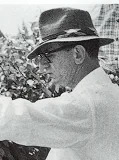
Emil Kosa Jr. lived a double life in the best sense. By day he painted the skies and cities that 20th Century Fox needed for its films. Nights and weekends he painted California for himself, and those watercolors and oils earned him a national reputation.
A musician's son who chose painting
Emil Kosa Jr. was born in Paris on November 28, 1903. His father, Emil Kosa Sr., was a Czech artist, and his mother, Jeanne Mares Kosa, was a pianist. After his mother's death the family moved to Bohemia. Around 1908 they spent a few years on Cape Cod, where his father worked with Alphonse Mucha, and then went back to Bohemia, where the boy went through school during and after World War I.
He grew up with both art and music lessons, and as a teenager he had to choose between them. He chose art. After the war he studied for three semesters at the Academy of Fine Arts in Prague.
Los Angeles, Paris and back
In January 1921 he joined his family, who had already settled in Southern California, and took classes at the Chouinard Art Institute in Los Angeles. He became a U.S. citizen in 1927 and spent the next year in Paris at the École des Beaux-Arts. There he studied traditional painting with Pierre Laurens and non-objective painting with Frank Kupka, one of the pioneers of abstract art. He came home to California in 1928.
His first work back in Los Angeles was murals and design for architects and decorating firms. With his father he also ran a business making decorative art for churches and auditoriums. When that work was slow, he painted portraits on commission and sold paintings through local galleries.
Joining the California watercolor movement
In the early 1930s Kosa became friends with Millard Sheets, and with Sheets' encouragement he set out to build a national name as a watercolorist. According to californiawatercolor.com, he sent as many as sixty watercolors a year to museum exhibitions around the country. He was among the first California painters accepted into the annual shows of the National Academy of Design and the American Watercolor Society in New York, and he helped bring the West Coast style to wider notice.
He was an active member of the California Water Color Society and served as its president in 1945. He was elected to the National Academy of Design (hence the N.A. after his name) and belonged to the American Watercolor Society and the Philadelphia and New York watercolor clubs. In Los Angeles his work was handled by Alexander Cowie's gallery in the Biltmore Hotel, and in New York by the Macbeth Gallery.
Thirty-five years at Fox
In 1933 Kosa joined the newly formed special effects department at 20th Century Fox and was soon made its art director. Much of his studio work was painting for matte shots, the painted backgrounds that were combined with live action on film. He is also credited with helping to create the studio's first on-screen logo. At the 36th Academy Awards in 1964 he shared the Oscar for visual effects for Cleopatra.
The studio job paid the bills, and he painted around it. By his family's account he often painted for three or four hours after dinner and spent most weekends outdoors with his watercolors or oils.
How he painted
LACMA's curators note that Kosa preferred the wet-into-wet technique, laying broad strokes of pigment onto large sheets, and that many of his prizewinning watercolors were of the Southern California countryside. His subjects run from rolling ranch land and storm skies to downtown Los Angeles streets, rail yards and oil fields. Laguna Art Museum included his Los Angeles city scenes in its 2016 exhibition City Life, Los Angeles: 1930s to 1950s.
He was also an in-demand portrait painter, especially in the 1950s. His portrait of Earl Warren is in the National Portrait Gallery in Washington, D.C. From the 1940s into the 1960s he returned now and then to non-objective painting, often with music as the theme. He died in Los Angeles on November 4, 1968.
In museums
Public collections holding his work include the Los Angeles County Museum of Art, the Museum of Fine Arts, Boston, the Santa Barbara Museum of Art, the San Diego Museum of Art and the National Portrait Gallery.
What collectors look for
Large 1930s and 1940s watercolors
The California-style sheets from his years of heavy exhibiting are the core of his market: ranches, hills, storms and town scenes painted wet-into-wet.
Los Angeles city scenes
Downtown streets, rail yards and industrial views tie him to the California Scene painters and are sought after.
Oils with presence
Western landscapes and canyon views on canvas or board, especially larger, well-preserved works.
Exhibition history
Old exhibition labels, society stickers and gallery labels on the back help place a painting in his career.
Timeline
Sources are listed in the site notes. Where accounts disagree, I've left the detail out or said so.
Own an Emil Kosa Jr. painting?
Send a few photos. I'll reply personally, and there's no obligation.
Get an offer Call or text (760) 943-8706